ASMAX S1 vs F1s Helmet Intercoms Core Features and Rider Experience
S1 or F1s? A side-by-side look at how ASMAX's two motorcycle helmet intercoms handle sound, range, and durability. 🏍️
Shopping for motorcycle helmet intercoms often means comparing two devices that look similar on paper but handle communication quite differently. The brand offers two headset models, the S1 and the F1s, each built around a different communication style. The sections below break down how the two compare across sound, range, and everyday durability.
ASMAX Helmet Intercoms: Two Distinct Product Lines
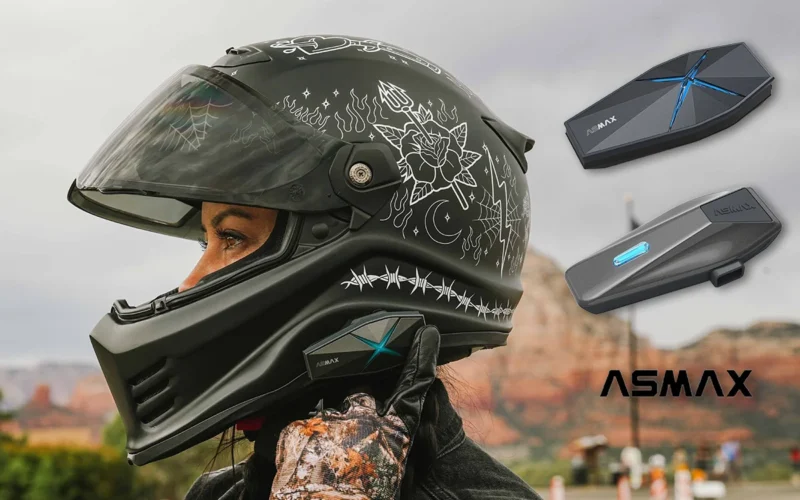
ASMAX builds its headset lineup around two motorcycle Bluetooth headsets, the S1 and the F1s, and also sells separate mount and audio accessory kits for the F1/F1s line. Both headsets support offline AI voice control, communication among up to 50 riders, and music sharing between paired units. The two models diverge mainly in mesh pairing, mounting hardware, and a few audio extras.
The S1 leans toward mesh-style group riding and includes a built-in FM radio tuner. The F1s instead adds custom EQ sound modes and swaps the mounting hardware for a different design. Riders picking between these motorcycle helmet intercoms are really choosing between those feature sets rather than between separate generations of hardware.

S1 Motorcycle Bluetooth Headset: Mesh Communication and FM Radio
The S1 runs Bluetooth 5.4 and attaches to a helmet using a clamp mount. ASMAX built in an FM radio tuner on this model, a feature not listed for its sibling headset. CloudTalk Mode and ASMAX Mode are both included, letting the S1 move between direct mesh pairing and network-based group calling.
The brand’s own FAQ page notes that Group Mode and Free Mode rely on Bluetooth or mesh connections, each carrying its own distance and brand limits, which is the layer the S1 uses for close-range group talk. The S1 carries an IPX7 waterproof rating and a 980mAh battery. Firmware updates arrive over the air, keeping the device current without a cable connection.
F1s Motorcycle Bluetooth Headset: Advanced Voice Control and Custom Sound
The F1s runs Bluetooth 5.3 and uses a snap-in mount rather than a clamp. It extends mesh intercom pairing to 10 connected units, two more than the S1 offers, while keeping the same offline AI voice command system across both headsets. Where the S1 offers FM radio, the F1s instead lists FM support as planned rather than active, and the platform gives it custom EQ sound modes in its place.
Like the S1, the F1s includes CloudTalk Mode, ASMAX Mode, music sharing, and over-the-air updates. Its battery is rated at 1250mAh, and it carries an IP67 protection rating. A separate mount-only kit and an audio-and-mic kit are sold for the F1/F1s line, pointing to a modular accessory setup rather than a single sealed unit.
Noise Reduction, Speaker Quality, and Audio Performance
Audio clarity is an area where ASMAX draws attention through its own customer feedback. One rider reviewing the F1s described sound as clear even at highway speed, with noise cancellation keeping conversations understandable, and that same reviewer noted being able to share a music track with another connected rider without taking hands off the handlebars. That combination of clear calls and simple sharing is the main audio point raised in available feedback.
Both motorcycle helmet intercoms in the lineup rely on Bluetooth pairing for calls and music. The F1s adds the custom EQ modes mentioned earlier, which stands out as the clearest audio-related difference between the two models based on available specifications. Riders weighing sound preferences alongside basic group-talk needs would look at this distinction first.
Communication Range: Direct Mesh Versus Cloud-Connected Modes
Group communication on these devices runs through two separate paths. ASMAX Mode combines mesh and network connection automatically, shifting to whichever stays stable as distance or terrain changes. CloudTalk Mode instead connects riders over mobile data with no fixed distance limit, as long as the network connection holds, and it supports up to 50 riders sharing one Room ID.
Reaching another rider on CloudTalk Mode mainly requires matching server regions, since a region mismatch can block a room from connecting. Mesh pairing still differs by model, with the S1 handling 8 units and the F1s handling 10. Both models fall back on CloudTalk Mode once a group grows past those mesh counts, since mesh and Bluetooth connections carry their own distance and compatibility limits.
Durability, Battery Life, and Real-World Reliability

Waterproofing differs slightly between the two models. The S1 carries an IPX7 rating, while the F1s is rated IP67, which also covers dust resistance alongside water exposure. Battery capacity follows the same pattern, with the S1 at 980mAh and the F1s at 1250mAh.
ASMAX backs its headset range with a 2-year warranty and 24/7 online support, according to the brand’s own site. One reviewer described a mount base issue on an F1s unit that support resolved by sending a replacement part. That kind of after-sale handling is part of what the brand points to when discussing reliability across its motorcycle helmet intercoms.
- The S1 runs Bluetooth 5.4, while the F1s runs Bluetooth 5.3.
- The S1 uses a clamp mount, while the F1s uses a snap-in mount.
- The S1 supports mesh communication across 8 units, while the F1s supports up to 10 units.
- The S1 carries an IPX7 waterproof rating, while the F1s carries an IP67 protection rating.
- The S1 includes a built-in FM radio tuner, while FM on the F1s is listed as planned.
- The S1 has a 980mAh battery, while the F1s has a 1250mAh battery.
- The F1s adds custom EQ sound modes, a feature not listed for the S1.
Both headsets fit into the same broader intercom lineup, built around different combinations of range, sound, and mounting preference.