Kurtens Blackout Curtain Tiers Single-Layer vs 3-in-1 Thermal and Acoustic
🌙 Single-layer or 3-in-1, Kurtens maps out which blackout curtain type actually suits a room's light, warmth, and noise needs.
Picking between blackout curtain types usually means weighing darkness against other needs like warmth or quiet. Kurtens addresses that choice with two distinct made-to-measure constructions, each aimed at a different balance of light-blocking, insulation, and sound reduction. A short look at how each is built shows which one answers which problem.
Understanding 100% Blackout: What Both Kurtens Ranges Deliver
Both ranges from Kurtens are described as blocking 100% of light, with 0 lux transmitted through the fabric itself. That figure applies to the material, not the window as a whole. A curtain that is too narrow or too short still lets daylight slip in around the edges, even when the fabric is fully opaque.
This is why Kurtens frames darkness as a combination of fabric and fit. Made-to-measure sizing is built to cover the full window opening and overlap at the sides, so that light cannot find a gap. Among the blackout curtain types on offer, both the single-layer and the 3-in-1 construction rely on this same sizing logic to achieve a genuinely dark room.
The Single-Layer Mottled Blackout Curtain: Simplicity and Weight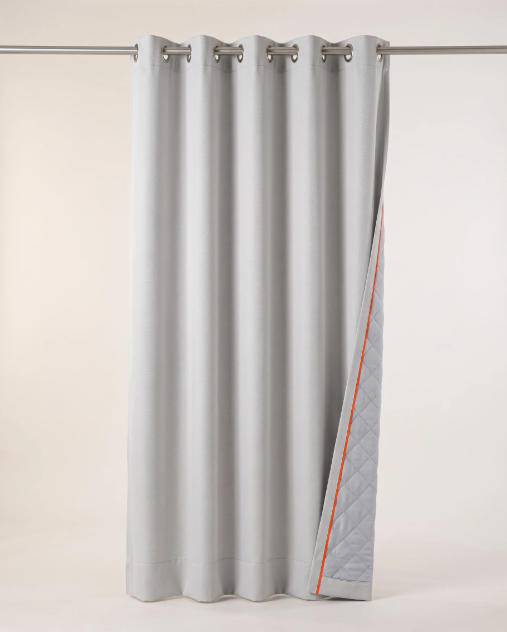
The single-layer mottled blackout curtain comes in six colours, including Sky Blue and Pink among the listed options. It uses one fabric layer to achieve total light blockage, rather than combining several layers for added function. This keeps it the simpler of the two blackout curtain types, with less bulk on the rod and an easier drape when opened.
Because there is no thermal or acoustic layer bonded to it, this version stays straightforward in construction. It suits rooms where blocking light is the main requirement, without the need for extra insulation or noise reduction. The mottled finish gives it a textured, slightly heathered look rather than a flat, uniform colour.
The 3-in-1 Thermal and Acoustic Blackout Curtain: Layered Performance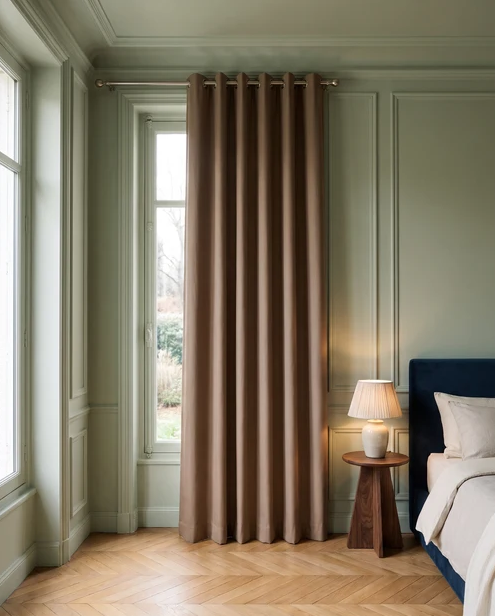
The second range from Kurtens is the 3-in-1 blackout, thermal, and soundproofing curtain, available in fourteen colours such as Anthracite Grey, Pastel Blue, Lavender, and Olive Green. Alongside full blackout performance, it adds up to 7°C of thermal gain and up to 22 dB of sound reduction, according to the brand’s own figures. These results are described as measured under laboratory or optimal test conditions, with real-world results depending on the window, the room, and how the curtain is fitted.
Unlike the single fabric used in the mottled range, this construction is built from a three-layer, 620 g/m² fabric, and that added density is what lets it carry thermal and acoustic function alongside blackout. Best sellers in this line include the Kurtens Thermal Velvet Curtain in shades like Forest Green, Navy Blue, and Burgundy.
How Fabric Weight and Construction Affect Blackout Capability
The 3-in-1 fabric sits at 620 g/m², built from three bonded layers rather than one, and that extra weight is also what sets it apart from the single-layer option both in handling and in how it carries thermal and acoustic performance. The density is not what produces the blackout effect itself, since both ranges already claim 100% blackout through different approaches to construction.
In practical terms, a heavier multi-layer curtain will hang and drape differently than a single-layer fabric. A lighter curtain moves more easily and takes up less visual bulk when open, while a heavier one carries more structure on the rod or track. Neither is described as outperforming the other on blackout itself, since Kurtens states that figure as 100% for both constructions when properly sized.
- The single-layer mottled blackout curtain uses one fabric to achieve 100% blackout, while the 3-in-1 curtain uses a three-layer, 620 g/m² fabric for the same blackout rating.
- Only the 3-in-1 range adds thermal performance, with up to 7°C of measured gain, which the single-layer option does not include.
- Sound reduction of up to 22 dB is specific to the 3-in-1 construction and is not part of the single-layer mottled range.
- The single-layer curtain comes in six colours, whereas the 3-in-1 range offers fourteen colour options.
- A bedroom needing only darkness may suit the lighter single-layer fabric, while a room facing outside noise or temperature swings points toward the heavier 3-in-1 construction.
Made-to-Measure Sizing: Why Fit Matters as Much as Fabric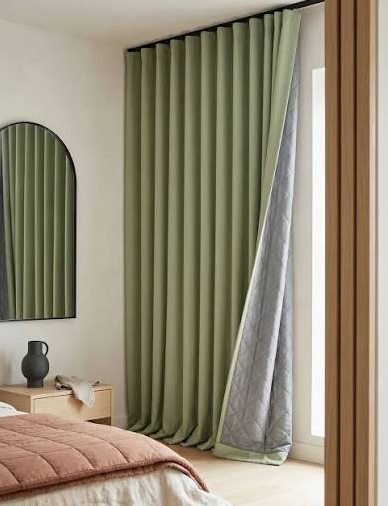
Kurtens offers standard sizes alongside made-to-measure dimensions, so a size that already covers the window with enough overlap can be used as is, while a window that falls outside those options can be matched with custom measurements instead. This flexibility runs across its curtain collections, not just the blackout ranges.
On individual product pages, sizing options for the 3-in-1 range stretch from widths as narrow as 100 cm up to 1000 cm, and heights from 150 cm up to 600 cm, depending on the colour and style selected. Fixing types are also chosen at this stage, with options including 40 mm eyelets for a round rod between 16 and 35 mm, pencil pleat for a track or rings with hooks, and rod pocket for a thin round rod. This step matters precisely because, as the brand’s own blackout pages state, fabric and sizing work together to block light fully.
Choosing Between Kurtens Blackout Ranges for a Child’s Room
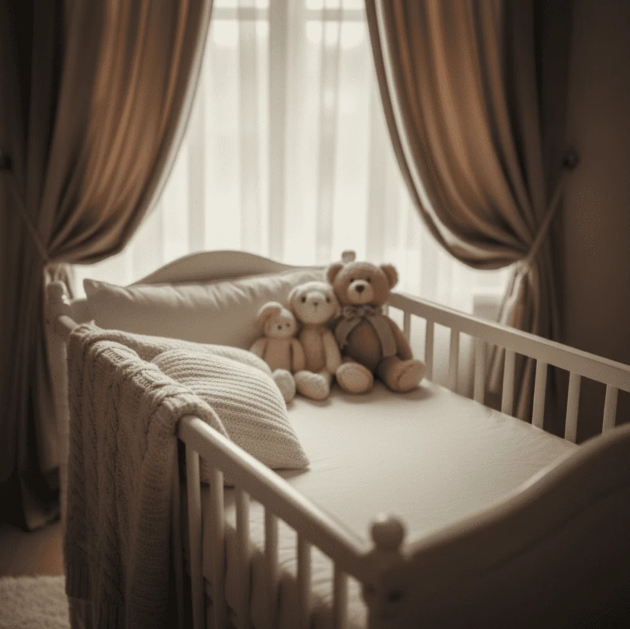
For a nursery or child’s bedroom, Kurtens points specifically to its made-to-measure blackout curtains designed for these spaces. Both the single-layer and 3-in-1 constructions are part of the wider blackout collection, and either can be sized to a child’s window using the same made-to-measure approach described above. The choice between them still comes down to whether thermal and acoustic performance matter for that room, or whether blackout alone covers the need.
A room facing a noisy street or a colder exterior wall may benefit from the layered 3-in-1 fabric and its stated 22 dB and 7°C figures. A room where only darkness during daytime naps matters might not need that added weight or layer count. Either way, the decision sits on the same sizing principle that runs through the whole range, since both blackout curtain types depend on accurate measurement to block light at the edges.
Across both constructions, the core proposition stays consistent: full blackout fabric, paired with sizing that closes the gaps around a window.